
Sustainable packaging has moved from a nice brand story to a practical business requirement. Customers want less waste, retailers want clearer material information, and regulators are putting more attention on recyclability, unnecessary packaging and substances of concern. In the European Union, the Packaging and Packaging Waste Regulation began applying in phases on August 12, 2026, adding fresh urgency for businesses that sell into European markets.
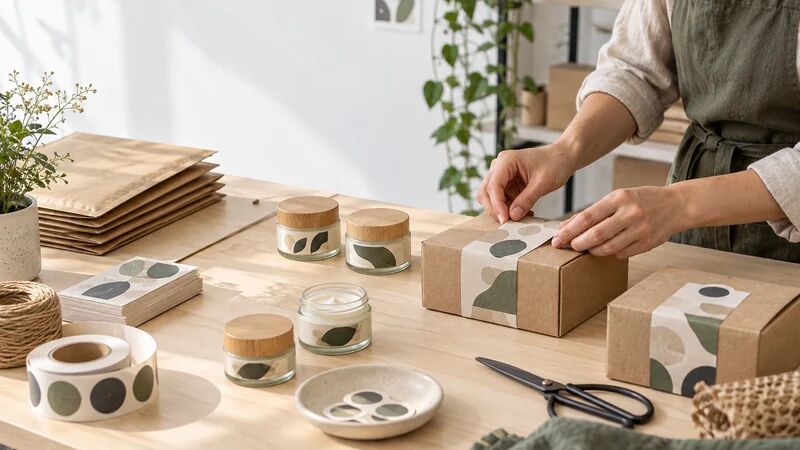
For growing brands, however, “eco-friendly” is rarely a simple material choice. A label must still protect important information, survive transport, look professional and release cleanly from its liner. A beautiful paper label that fails in a refrigerator is not sustainable if the product has to be relabeled or discarded. The goal is to reduce impact while choosing a label that works for the real packaging, environment and supply chain.
This guide explains how to make that decision—and how to avoid vague claims that can weaken customer trust.
Start With the Whole Package, Not the Label Alone
A label is a small component, but it can affect how the complete package is sorted and recycled. Before comparing stocks or finishes, map the packaging system:
– What is the primary container: glass, paperboard, metal or plastic?
– Will the package be exposed to water, oil, refrigeration, sunlight or abrasion?
– Does the customer need to remove the label before recycling or reusing the container?
– Is the product sold locally, shipped through ecommerce or exported?
– Which information must remain readable throughout the product’s life?
This prevents a common mistake: choosing a material because it looks natural rather than because it supports the package’s actual end-of-life route. A kraft paper sticker can reinforce a handmade look on a dry cardboard box. A waterproof film label may be the more responsible choice for a refillable bottle if it stays legible through repeated handling. Sustainability depends on fitness for purpose, not appearance alone.
Four Label Materials to Consider
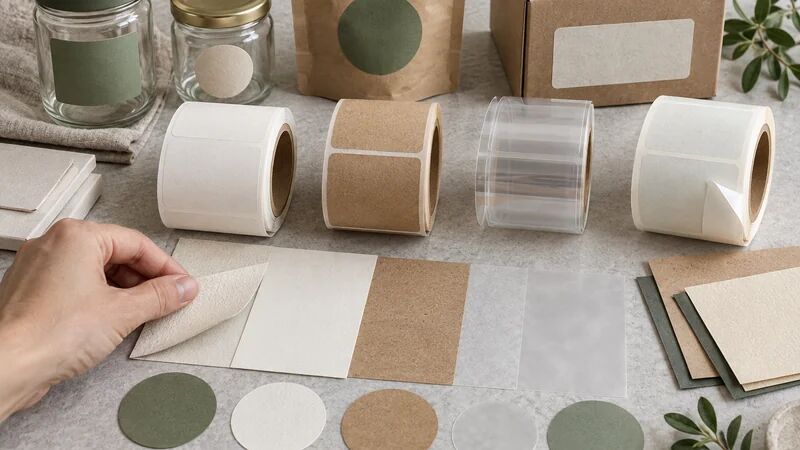
1. Paper Labels for Dry, Short-to-Medium-Life Applications
Paper labels are widely used on cartons, envelopes, candles, dry food packaging and retail bags. They offer excellent print quality, are generally cost-effective for volume orders and can visually integrate with paper-based packaging.
Choose paper when the application stays mostly dry and indoors. Ask your supplier about the face stock, coating, adhesive and release liner rather than relying on the word “paper.” A heavy laminate or incompatible adhesive can change the recyclability of the finished package. For an understated look, matte paper works well; for stronger color and contrast, a coated or glossy paper may be appropriate.
2. Kraft Paper Labels for Natural Brand Positioning
Kraft stickers are popular with coffee roasters, bakeries, candle makers, handmade goods and natural-product brands. Their visible fibers and warm brown tone communicate simplicity without needing a complicated design.
Kraft stock changes how ink colors appear, so test your artwork before production. White, yellow and pastel colors may look muted unless white ink is printed beneath them. Dark one- or two-color designs, bold type and simple line art often produce the strongest result. Kraft labels are best for dry surfaces; they are not automatically water-resistant because they look durable.
3. Durable Film Labels Where Performance Matters
Beverage bottles, bathroom products, outdoor equipment and refrigerated foods may need waterproof stickers. Film can reduce smudging, peeling and replacement waste when paper cannot survive the use environment.
If film is necessary, keep the structure as simple as possible. Ask whether the label material and adhesive are compatible with the container’s recycling stream and whether a thinner construction can meet the same performance target. “Use less, but make it last” is often a better principle than forcing a paper solution into a wet application.
4. Removable or Wash-Off Labels for Reuse Systems
Reusable jars, bottles and shipping containers create a different requirement: the label may need to stay attached during use but release during washing or return processing. A removable adhesive can help customers separate the components without scraping or solvent.
Always test removal on the exact container. Surface energy, texture, coating, temperature and dwell time all affect adhesion. A label that peels cleanly after one day may behave differently after three months in a humid kitchen.
Adhesive Is as Important as Face Stock
Brands often spend time choosing paper texture and finish, then treat adhesive as a technical detail. In practice, the adhesive determines whether the label performs—and whether the package can be reused or recycled efficiently.
Permanent adhesive is appropriate when safety, traceability or long-term branding matters. Removable adhesive suits temporary promotions and reusable containers. Freezer-grade adhesive is designed for cold, moist conditions, while standard adhesive may lift at the corners. For food, cosmetics or other regulated applications, share the end use with your supplier so the complete construction can be evaluated.
A reliable sampling process should include:
- Application to the final container, not a substitute.
- Testing at the expected application temperature.
- Exposure to moisture, oil, abrasion and sunlight where relevant.
- Observation after 24 hours, one week and the expected product life.
- A recycling or removal check based on the target market.
Use Finishes Selectively
Foil, laminate, spot effects and specialty coatings can create premium shelf impact, but more layers do not automatically create more value. In 2026, restrained design often looks more confident: a distinctive label shape, strong typography and one tactile material can do more than several decorative processes competing for attention.
Use a protective finish when it solves a real problem, such as abrasion or condensation. If the label remains indoors and is handled only a few times, an unlaminated matte stock may be sufficient. Reducing unnecessary layers can lower material use, simplify production and support a more honest sustainability story.
Make Environmental Claims Specific
Customers are increasingly skeptical of broad terms such as “green,” “planet-friendly” and “100% sustainable.” Replace them with specific, verifiable statements. Depending on your documented materials and market rules, useful language may describe recycled content, responsible fiber sourcing, removability or disposal instructions.
Avoid placing a recycling symbol on a package simply because one component can technically be recycled. Local collection systems differ, and the container, label, adhesive and decoration can behave differently together. Confirm claims with your material supplier and legal or compliance adviser, especially when selling across borders.
A QR code can provide expanded instructions without crowding the front label. It can direct customers to localized disposal guidance, refill locations, ingredient details or the story behind a packaging change. The printed label still needs essential information and good contrast, but the digital layer gives brands room to explain the details.
A Practical Sustainable Label Brief
Before requesting a quote, prepare the information your printer needs:
– Container material, shape and surface finish
– Label size, shape and application area
– Indoor, outdoor, chilled, frozen or wet-use conditions
– Expected product life
– Hand or machine application
– Permanent, removable or wash-off adhesive preference
– Required print colors and finishes
– Target sales markets and relevant packaging requirements
– Order quantity and whether artwork versions vary by SKU
Providing these details early helps a printer recommend a construction rather than simply reproduce an artwork file. It also reduces sampling rounds and lowers the risk of ordering a label that looks right but performs poorly.
Sustainable Packaging Should Still Sell the Product
The most effective sustainable label does three jobs at once: it supports the packaging system, communicates clearly and gives the customer confidence in the product. That may mean textured kraft paper for a dry artisan box, a clean removable label for a reusable jar or a durable film for a bottle that faces condensation.
There is no universal “greenest” sticker. There is a better-matched label for each use case—and the best decisions are based on evidence, testing and a simple structure.
XY produces custom paper, kraft, waterproof and specialty labels in a wide range of sizes, shapes and finishes. Contact us with your container material, use conditions, artwork and quantity to discuss a label solution for your packaging project.