
The familiar retail barcode is entering a major transition. Through its “Ambition 2027” initiative, GS1 has set a goal for retail point-of-sale systems worldwide to be capable of reading defined GS1-standard 2D barcodes by the end of 2027, alongside existing linear barcodes. For brand owners, 2026 is the ideal time to understand the options, run print tests and decide which use cases are worth pursuing.
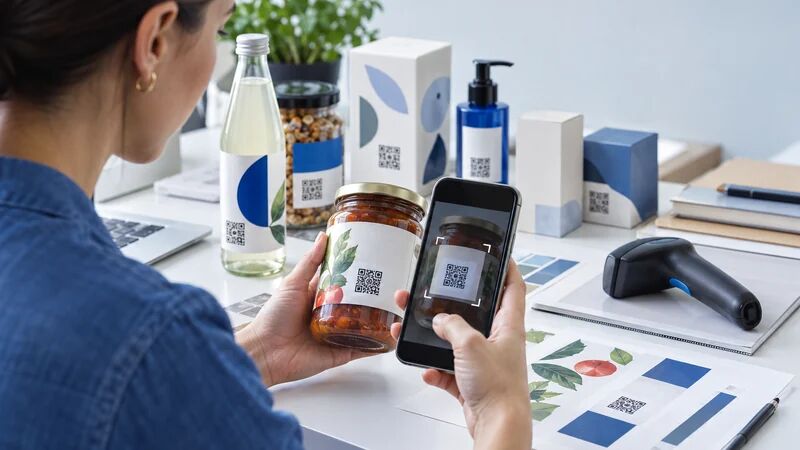
This is more than a change in symbol shape. A GS1-enabled 2D barcode can carry a product identifier and connect to additional data or online information. Depending on the implementation, brands may use it to support traceability, batch or lot data, expiry dates, product instructions, recycling information, authentication and customer experiences.
The opportunity is significant, but a smart label only works when the code, artwork, packaging and destination are planned together.
What Makes a Label “Smart”?
A smart label connects a physical item to digital information or an automated process. The connection may be created by a QR code, Data Matrix, NFC tag or another technology. For most consumer packages, a printed 2D code is attractive because it requires no electronic component and can be produced with the rest of the label.
Not every QR code is a retail barcode. A conventional marketing QR code usually opens a fixed web page. A GS1-standard 2D barcode can identify the trade item and, when implemented with GS1 Digital Link, connect that identity to online resources. The correct choice depends on whether the code is intended for consumer engagement, checkout, inventory, traceability—or several functions together.
Before creating artwork, speak with your GS1 Member Organisation and your retail, software and printing partners. Product identifiers and data structures should be established before anyone decides how large the printed square will be.
Why Brands Are Paying Attention Now
Traditional EAN/UPC barcodes are excellent at identifying a product, but space is limited. A more capable 2D code can support richer data and experiences from one printed area. Potential applications include:
– Opening localized product instructions or video demonstrations
– Providing ingredient, allergen or care information
– Sharing recycling or refill guidance
– Connecting customers to registration, warranty or loyalty pages
– Carrying lot, batch, serial or expiry data where the chosen standard allows it
– Supporting recall, inventory and traceability workflows
The customer experience can also become easier to maintain. With a properly planned resolver or digital-link structure, the destination content may be updated without redesigning every label. The physical code stays in place while the digital information evolves.
That flexibility does not remove the need for governance. Someone must own each link, maintain the destination, protect customer privacy and monitor what happens when a product or campaign ends.
Do Not Remove the Linear Barcode Too Early
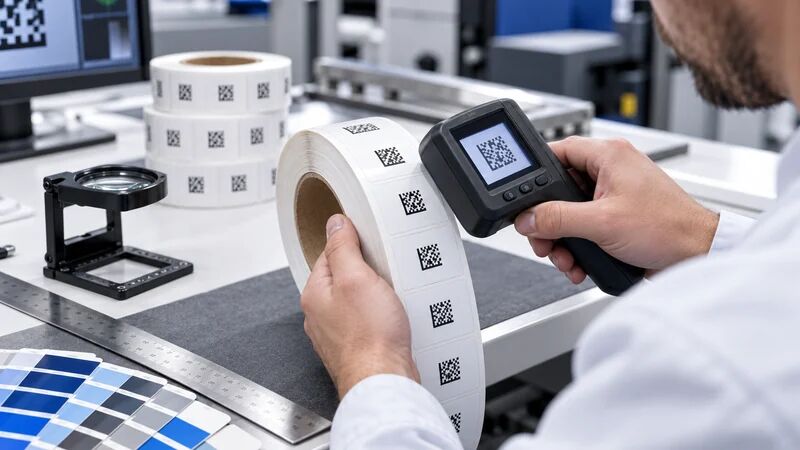
During the transition, GS1 guidance describes a period of dual marking in which a pack may carry both the existing linear barcode and a 2D barcode. Retail readiness will vary by market, retailer, scanner hardware and software. A code that scans on a consumer’s phone is not proof that it will process correctly at checkout.
Before changing a retail package:
- Confirm the data carrier and syntax with GS1 guidance.
- Ask retail partners about their POS migration timeline.
- Keep the existing barcode where required during transition.
- Validate how both symbols behave near each other.
- Test the finished production label, not only a PDF proof.
This is a cross-functional project involving packaging, regulatory, IT, operations, marketing and retail partners. Treating it as a last-minute graphic-design task creates avoidable risk.
Seven Print and Design Rules for Reliable Scanning
- Protect the Quiet Zone
Every code needs clear space around it. Text, borders, illustrations or another code placed too close can reduce readability. Build the quiet zone into the template so it cannot be accidentally filled during later artwork revisions.
- Use Strong Contrast
Dark modules on a light, uniform background remain the safest choice. Metallic effects, transparent backgrounds, gradients and busy imagery may look impressive but can confuse a scanner. If the brand design requires an unusual combination, test it under multiple lighting conditions and with the intended devices.
- Print at an Appropriate Size
More encoded data generally creates a denser symbol. Reducing a dense code to fit a crowded panel may make individual modules too small for reliable reproduction. Size should be determined from the data, printing process, substrate and scanning environment—not from visual preference alone.
- Avoid Folds, Seams and High Curvature
A code crossing a carton fold or wrapping around a narrow bottle can become distorted. Place it on the flattest practical surface and consider how the customer or cashier will present the item to a scanner.
- Allow for Print Movement
Fine codes demand consistent registration, ink control and cutting. Keep critical marks away from trim lines, and use a label construction suited to the press and application method. A roll-label format can support efficient machine application, while sheets may be suitable for small pilots and mixed designs.
- Test the Real Surface and Finish
Gloss, condensation, texture and transparent material can all affect performance. A code on a matte white proof may behave differently after lamination or when applied to a curved, chilled bottle. Request samples using the actual face stock, finish, adhesive and container.
- Verify, Do Not Only Scan
A successful phone scan is encouraging, but formal barcode verification evaluates symbol quality against defined parameters. For retail or supply-chain use, ask which verification method and report your partners require. Repeat checks after artwork changes, material changes and production setup.
Build a Useful Customer Journey
The code should earn its place on the package. Sending every visitor to the homepage adds little value. Match the destination to the product and the moment of use.
A skincare label might open application instructions and ingredient details. A food package could lead to recipes, allergen information and disposal guidance. An equipment label might provide installation video, spare parts and warranty registration. A promotional sticker can unlock a limited collection or event page.
Keep the landing page fast and mobile-first. State what the customer receives before asking for personal data. Include a short printed call to action—such as “Scan for care instructions”—without crowding the code’s quiet zone. Maintain an accessible text route for essential information rather than putting mandatory content only behind a scan.
A 2026 Pilot Plan for Small and Mid-Sized Brands
You do not need to redesign the entire catalog at once. A controlled pilot creates better evidence.
– Select one product family with stable packaging.
– Define one operational goal and one customer goal.
– Confirm identifiers, data ownership and destination URLs.
– Produce several code-size and material samples.
– Test across phones, production scanners and relevant POS systems.
– Expose samples to real handling, moisture and abrasion.
– Record scan success and customer behavior.
– Refine the template before expanding to more SKUs.
Limited runs can be produced as sticker sheets for prototypes. When the design is stable and application volume increases, sticker rolls can support faster, more consistent labeling.
Printing Is the Bridge Between Data and Experience
A 2D barcode may contain sophisticated data, but the customer and retailer interact with ink on a physical surface. Contrast, size, material, finish and placement determine whether that data remains accessible after production and handling.
Start early, keep the use case clear and validate the final package with every relevant partner. The brands that prepare now can approach Sunrise 2027 as an opportunity to improve information, traceability and engagement—not as a rushed compliance exercise.
XY produces custom roll and sheet labels across paper, vinyl, waterproof and specialty constructions. Contact us with your artwork, code specifications, label size, application method and order quantity to discuss sampling and production.